Netanyahu vs. Bennett: Two Models of Leadership, One Crisis of Responsibility
part of Rabbi Moshe Pitchon’s Israel After Charisma, a pre-election series examining the political re-emergence of Naftali Bennett ahead of Israel’s next national elections.
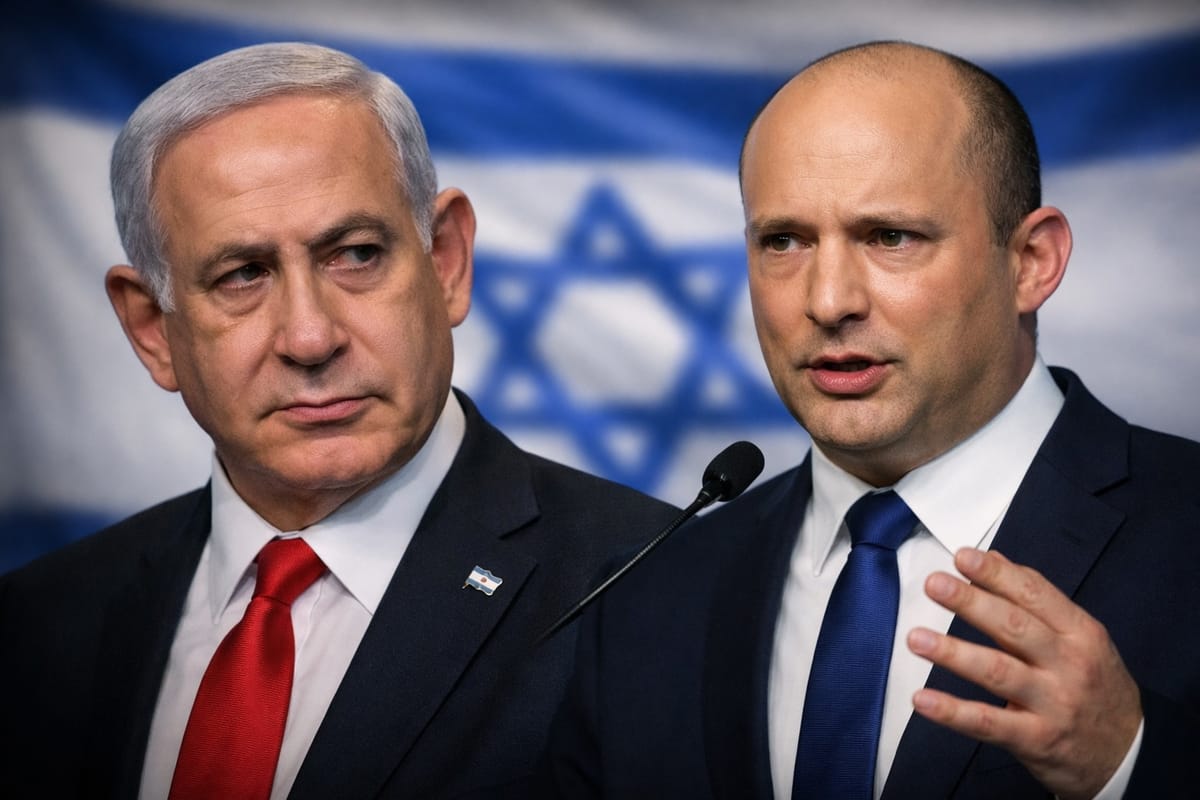
This article is part of Rabbi Moshe Pitchon’s Israel After Charisma, a pre-election series examining the political re-emergence of Naftali Bennett ahead of Israel’s next national elections.
Rather than focusing on campaign tactics or polling fluctuations, the series asks a deeper question: what kind of leadership is Israeli society seeking now — and why?
After years of political instability, repeated elections, and growing civic fatigue, Israeli politics remains largely structured around the long dominance of Benjamin Netanyahu and the difficulty of articulating a credible alternative. Bennett’s renewed presence matters not only as an electoral variable, but as a lens through which to examine competing models of leadership, responsibility, and democratic authority under conditions of permanent pressure.
Israeli politics over the past decade can be read as a prolonged confrontation between two styles of leadership, embodied most clearly by Benjamin Netanyahu and Naftali Bennett.
This confrontation is often described in ideological or personal terms. More fundamentally, however, it reflects two competing models of how responsibility is distributed in a democracy under existential pressure.
Netanyahu’s leadership rests on a powerful form of political charisma. It is built on: mastery of narrative, a sense of historical mission, and the projection of indispensability.
Over time, this charisma has functioned as a gravitational force. Political meaning, security anxiety, and even moral judgment have been drawn upward toward the figure of the leader. Supporters do not merely endorse policies; they express trust in Netanyahu as the singular bearer of responsibility for Israel’s fate.
This has produced a paradox. The stronger the leader appears, the more responsibility migrates away from institutions and citizens. Criticism becomes existentially charged. Accountability is personalized. Politics becomes a referendum not on decisions, but on loyalty.
Netanyahu’s model offers reassurance in a threatening environment — but at a cost:
responsibility becomes centralized, and therefore fragile.
Bennett represents almost the opposite instinct. His leadership style is deliberately non-messianic, managerial rather than mythic, pragmatic rather than symbolic, coalition-based rather than polarizing. Bennett does not seek to absorb national anxiety into his person. Instead, he attempts — often awkwardly and without rhetorical flourish — to redistribute responsibility back into institutions, coalitions, and procedures.
This is why Bennett is frequently perceived as lacking charisma. But that perception is misleading. What is labeled “lack of charisma” is in fact a refusal to function as a moral substitute for the public. His weakness is political visibility. His strength is ethical architecture.
Current polling and renewed public attention to Bennett are not simply reactions to Netanyahu fatigue. They reflect something deeper: a growing unease with over-personalized responsibility.
After years of political paralysis, repeated elections, and moral exhaustion from crisis management, many Israelis are not asking: “Who can save us?” They are asking: “Is there a way to govern that does not require believing in a savior?” Bennett’s re-emergence speaks to this unarticulated question.
From a Jewish perspective, the contrast is stark. Judaism permits strong leadership — Moses himself is decisive — but it never allows leadership to replace collective moral agency. Covenant is addressed to a people, not outsourced to a king. Hineni- here I am, I take responsibility- cannot be pronounced by proxy.
Netanyahu’s charisma risks becoming a form of delegated conscience. Bennett’s restraint attempts, imperfectly, to preserve a culture where responsibility remains distributed, disputable, and human.
The Israeli political divide, then, is not only right versus left, or security versus diplomacy. It is between: a politics that concentrates meaning and responsibility in a single figure, and a politics that accepts discomfort in order to keep citizens morally engaged.
In a society under permanent pressure, the temptation to choose the first is immense. But Israel’s democratic resilience may depend on the second.
Rabbi Moshe Pitchon is a philosopher and public intellectual whose work examines responsibility, moral agency, and Jewish thought under conditions of historical and technological pressure. He is the author of several books on Israeli politics and Jewish ethics, including Something New Is Happening: The Life and Times of Naftali Bennett. He writes from the United States and is not affiliated with any Israeli political party or campaign.