Third Jewish Commonwealth Issue #6
“The next election will be the most difficult and most critical ever held in Israel”-Yair Lapid. What happens in Israel doesn’t stay in Israel
Israel Elections 2026 Brief
Serious Analysis for a Decisive Election
Issue #6|June 11 2026
MAIN BRIEFING
Yair Lapid: The Politics of Coalition
Among the major figures competing to shape Israel after the Netanyahu era, Yair Lapid occupies a unique position. Unlike Naftali Bennett, whose authority derives from management and entrepreneurship, or Gadi Eisenkot, whose credibility emerges from military command, Lapid's political identity rests on an idea: that Israel's future depends on preserving a democratic center capable of governing a deeply divided society.
And unlike Bennett, Eisenkot, Lieberman, or Golan, Lapid represents something different: he is the principal political advocate of Israeli centrism itself.
Lapid's significance lies less in his biography than in the political experiment he embodies. More than any major Israeli politician of the last decade, he has attempted to construct a coherent centrist alternative — situated between Labor Zionism and Revisionist nationalism, between the secular left and the nationalist right, and between ideological purity and coalition pragmatism — arguing that Israel's principal political divide is no longer between left and right, but between democratic responsibility and ideological extremism. Whether Israelis agree with that diagnosis may determine not only his political future, but the future shape of Israeli politics itself.

Lapid entered politics in 2012 after a successful career as a journalist, television personality, columnist, and public commentator. Critics dismissed him as a celebrity candidate lacking military credentials and governmental experience. Yet few figures in modern Israeli politics have advanced as rapidly.
Over the course of a decade, he served as Finance Minister, Foreign Minister, Opposition Leader, Alternate Prime Minister, and eventually Prime Minister of Israel.
Lapid's most significant political achievement, however, may not have been becoming prime minister, but making possible the government that temporarily ended Benjamin Netanyahu's long tenure.
He repeatedly subordinated his personal ambitions to coalition-building, first by joining Benny Gantz in Blue and White (Kahol Laban) and later by allowing Naftali Bennett to assume the premiership despite leading a smaller parliamentary faction. These decisions established Lapid as perhaps the most effective coalition builder of his generation.
The Bennett-Lapid government (June 13, 2021–December 29, 2022) brought together nationalists, centrists, leftists, secularists, conservatives, and, for the first time in Israeli history, an independent Arab party. Whether viewed as a political miracle or an unstable experiment, it represented Lapid's conviction that democratic societies are governed through compromise rather than ideological victory.
Lapid's argument is that modern societies face complex problems that cannot be solved through ideological absolutism. Government, in his view, is not about implementing perfect theories but about balancing competing interests and managing unavoidable tradeoffs.
His centrism is not merely electoral positioning. It is a governing philosophy rooted in responsibility, moderation, coalition-building, and democratic restraint.
This explains why Lapid places portraits of David Ben-Gurion and Menachem Begin side by side in his office. He sees himself occupying the space between Israel's two strategically opposing political traditions rather than fully belonging to either one.
Since October 7 and the judicial reform controversy, Lapid has increasingly framed Israeli politics as a struggle over the country's democratic character. He argues that the central debate is no longer left versus right but whether Israel can remain simultaneously Jewish and democratic.
He presents himself as the defender of liberal democratic institutions, judicial independence, and civic equality while maintaining a strong commitment to Zionism and national security.
This position has attracted support from many Israelis who do not identify with the traditional left but are uneasy with the direction of the current coalition.

Lapid's critics, however, argue that his greatest strength is also his greatest weakness.
To supporters, centrism reflects maturity and realism. To opponents, it reflects ambiguity and lack of conviction. Critics portray him as a media personality rather than a statesman, accuse him of excessive focus on image, and question whether a politician whose primary message is moderation can inspire the electorate during moments of national crisis. Others argue that his party's internal structure is highly centralized and insufficiently democratic.
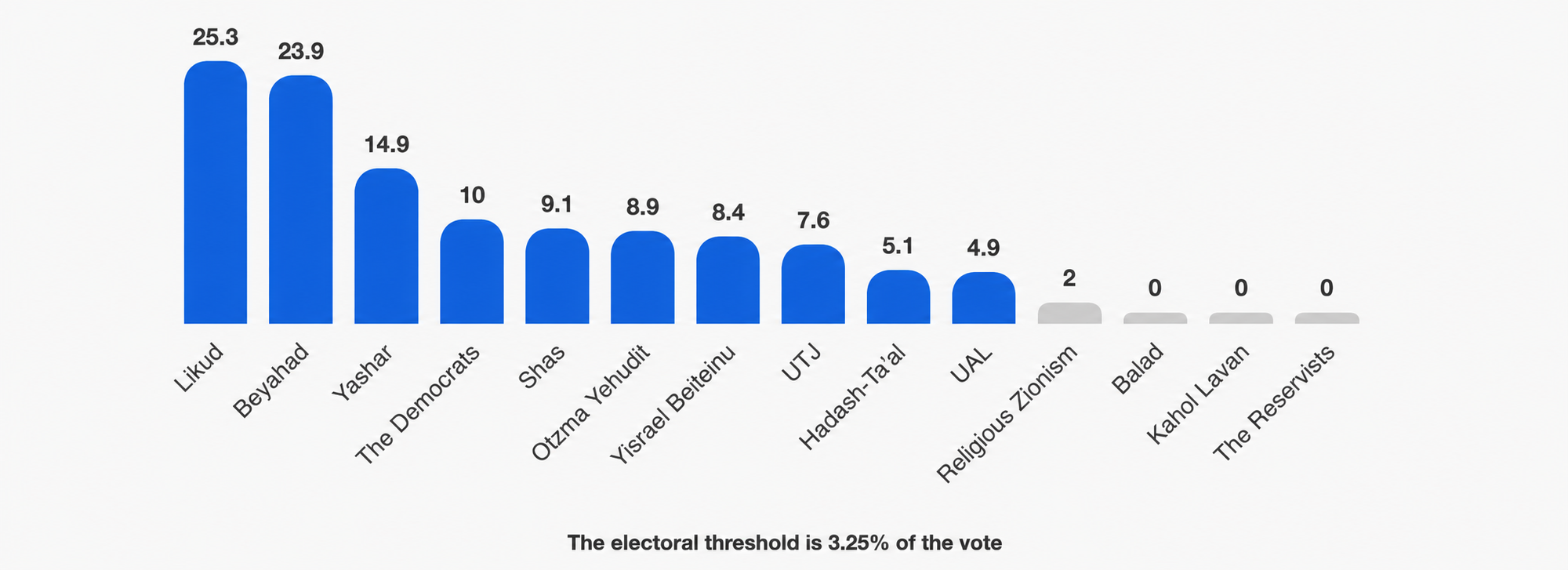
In April 2026, Yair Lapid made a most consequential strategic decision. He agreed to merge his party- Yesh Atid with Naftali Bennett's newly formed political movement under a joint electoral framework known as Beyahad ("Together"), creating what immediately became the most significant challenger to Benjamin Netanyahu ahead of the 2026 elections. Bennett was designated to lead the joint list, while Lapid accepted the second position.
The decision reflected a pattern that has characterized Lapid's political conduct for more than a decade. As he had previously done with Benny Gantz in Blue and White and later with Bennett in the 2021 coalition government, Lapid again demonstrated a willingness to subordinate personal ambition to broader political objectives. His calculation was straightforward: defeating Netanyahu would require the consolidation of Israel's fragmented opposition rather than competition among its leaders.
The creation of Beyahad also represented an evolution in Lapid's understanding of Israeli politics. For years he presented himself as the leader of the center. By 2026 he appears increasingly willing to serve instead as one of the architects of a broader democratic and Zionist coalition that stretches from Bennett's moderate right to the secular liberal center represented by Yesh Atid.
Whether Beyahad succeeds or fails, the alliance may ultimately be remembered as Lapid's most important political legacy: the attempt to transform opposition to Netanyahu from a collection of competing parties into a single governing alternative.
Lapid's repeated willingness to build political partnerships even at the cost of his own place at the top of the ticket is what makes him distinctive among the major contenders of 2026.
Lapid is not running to reinvent Israel. He is running to normalize it.